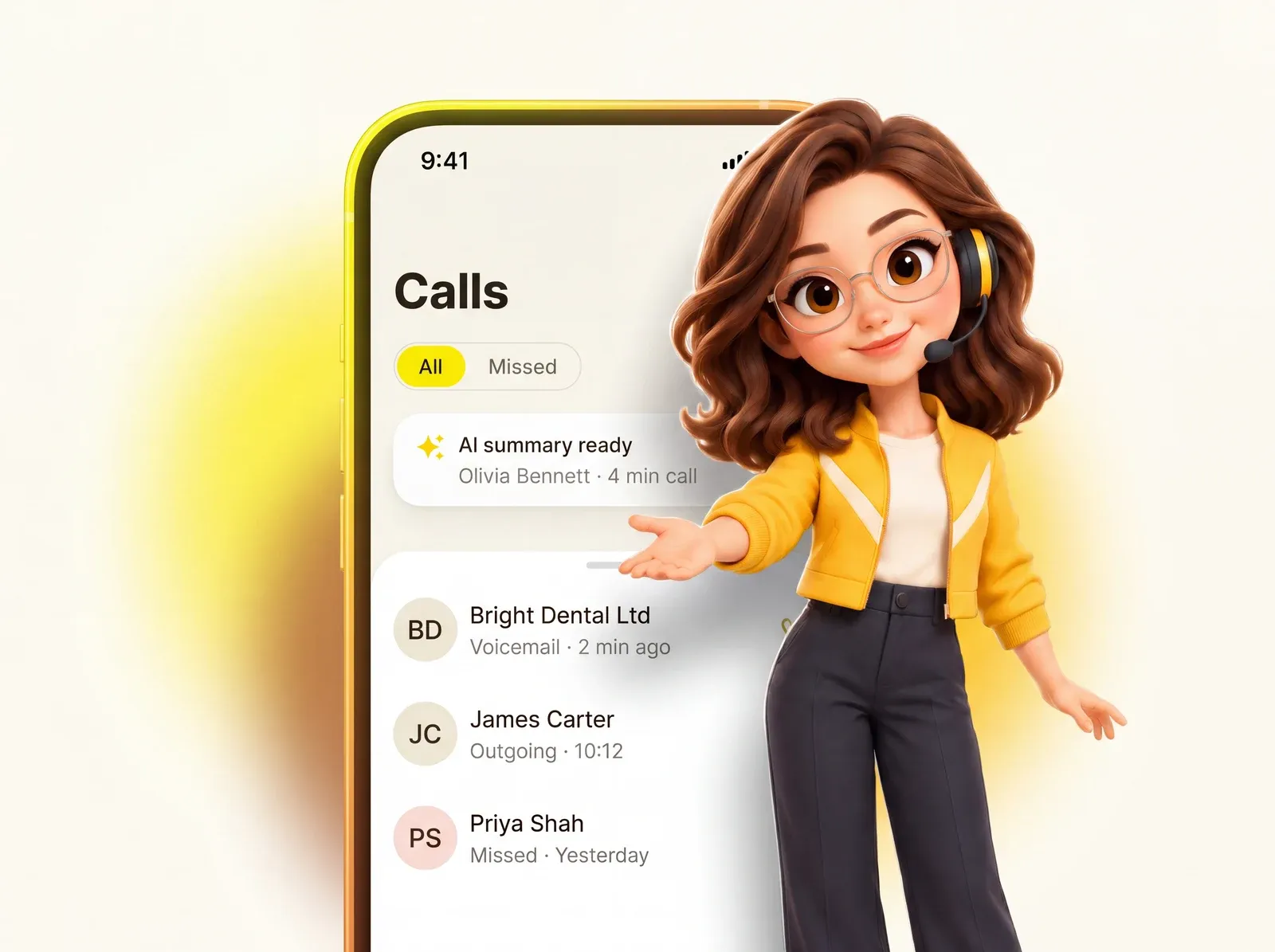
Think about the last time you rang a business and the person on the other end just got it. You hadn’t finished explaining, but they’d already picked up that you were in a rush, or worried, or quietly fuming. So they slowed down, skipped the small talk, or said “right, let’s get this sorted”.
That has very little to do with words. It’s tone, pace, the small sigh before you speak, the half-second pause that says you’re not quite sure. People read all of it without thinking. Until very recently, AI phone agents read almost none of it.
That is starting to change, and quickly. In this post we look at why voice AI has struggled to hear emotion, what Block’s new Dessa model tells us about where things are heading, and which industries stand to benefit most, both now and over the next few years.

Why most voice AI misses how we feel
Most voice agents in use today, including many of those answering business phones right now, work like a relay race with three runners:
- Speech-to-text turns what the caller says into a transcript.
- A large language model reads the transcript and writes a reply.
- Text-to-speech reads that reply back out loud.
This setup works well. It’s flexible and reliable, and it’s a big reason AI phone agents went from novelty to normal in just a couple of years. But it has a blind spot. The moment speech becomes text, everything that isn’t a word disappears. A transcript of “fine, that’s fine” looks exactly the same whether the caller is relieved or about to hang up in frustration.
It also explains why AI calls can still feel a little stilted. Each runner has to wait for the one before to finish, so the system has to guess when you’ve stopped talking. Pause to think and it might jump in. Say “mm-hmm” while it’s speaking and it might stop dead.
Block, the company behind Square and Cash App, put it bluntly when it introduced its new model, saying current voice AI remains “unable to register the emotion in a speaker’s voice.”
Enter Dessa: an AI that learned to talk by listening
In late October 2026, Block’s small in-house AI research lab unveiled Dessa, a speech model that skips text entirely. Sound goes in and sound comes out. Ragavan Thurairatnam, who leads the lab, described it as “a GPT-3 moment for speech”.
According to Block, a few things make Dessa stand out:
- It was trained only on human conversation. No text and no pretrained language model. It learned language from audio alone, and Block says it needed hundreds of times fewer words than a typical large language model to do so.
- It’s full-duplex. It listens and talks at the same time, the way people do. It drops in little “yeah”s and “got it”s while you speak, and it has learned from real conversations when it’s appropriate to interrupt.
- It hears emotion, and expresses it. Block’s demos show it picking up on, and producing, laughter, sighs, sarcasm and shifts in tone, and adjusting its volume when asked.
- It’s surprisingly light. Block says it was trained on a single NVIDIA GB200 NVL72 system and runs faster than real time on a high-end MacBook Pro.
A little healthy caution is needed. Dessa is a research preview, not a product. Access is currently limited to a small group of AI safety researchers, there’s no published paper or independent benchmark yet, and reviewers who have listened to the demos found some clips remarkably natural and others a bit stiff. The claims above are Block’s own.
But that isn’t really the point. Dessa matters because of the direction it points in. A small team has shown that an AI can learn not just what we say but how we say it, straight from sound. That’s a big signal for where the whole industry is going.
It’s not just Block
Dessa arrived in the middle of a busy autumn for voice AI. In September 2026 OpenAI released GPT-Live-1, its own full-duplex voice model, to developers, and Google, xAI, Alibaba and NVIDIA have all released full-duplex speech models this year. Investors have noticed too. Voice AI startups raised more than $7 billion in the first quarter of 2026 alone, compared with around $1 billion a year earlier, according to Financial Times figures.
The early results are encouraging. OpenAI says the language-learning app Speak cut interruptions during learners’ thinking pauses by almost 80% compared with older turn-based systems. That’s exactly the kind of small, human detail that makes a conversation feel respectful rather than robotic.
It’s worth staying clear-eyed, though. These models are getting much better at the rhythm of conversation, but completing complex tasks reliably is a separate challenge. On one recent customer service benchmark, the best published score was around 74.5%. Listening better is a huge step forward, but it doesn’t replace good design, clear processes and a sensible route to a human.
What “listening” will actually mean on a phone call
So what changes when AI can hear how you feel? In practical terms, the next generation of AI phone agents should be able to:
- Notice frustration early and hand over to a person before a complaint escalates, rather than after the caller has repeated themselves three times.
- Give people time to think. An older caller looking for a policy number, or a patient trying to remember the name of a medication, shouldn’t be talked over.
- Match the mood of the call. Upbeat and quick for someone booking a table. Calm and unhurried for someone reporting a bereavement or a burst pipe.
- Pick up on hesitation. A “yes” that sounds unsure might deserve a quick “would it help if I went over that again?”
- Sound like they’re paying attention. Small acknowledgements while the caller is talking make a conversation feel two-way.
None of this is about making AI pretend to be human. It’s about making AI better at the basic courtesy we expect from anyone who answers the phone.
Where emotionally aware voice AI matters most

Industries benefiting right now
Healthcare. This is where good listening matters most, and where the gains are already visible. At University Hospitals Sussex NHS Foundation Trust, a conversational AI assistant helped cut patient call waiting times from over 30 minutes to under three, with abandoned calls down 75%. Meanwhile, an NHS trial led by Ufonia with the Universities of York and Newcastle, funded by Innovate UK, is testing an AI phone assistant called Dora to check in on patients with osteoporosis. Tellingly, linguistics experts studied how experienced clinicians show empathy, including their tone, wording and timing, and built those patterns into Dora’s conversations.
Banking, financial services and insurance. According to Grand View Research, this is already the largest market for AI voice agents. Think balance queries, card problems, claim updates and payment reminders. On these calls the customer is often anxious, so tone matters as much as accuracy.
Customer service and contact centres. Gartner predicts that by 2029, agentic AI will resolve 80% of common customer service issues without human help. The teams that get this right will be the ones whose AI can tell a routine query from a customer who is close to walking away.
Appointment-based and local businesses. Clinics, dentists, salons, estate agents, tradespeople and restaurants all depend on the phone. Grand View Research names appointment scheduling as the fastest-growing use of AI voice agents, and it’s easy to see why. An agent that answers every call, books the slot and sounds friendly doing it stops missed calls turning into missed revenue.
Hospitality and travel. Bookings, changes, late check-ins and the 2am “where’s my room?” call. High volume, often time-sensitive, and much better handled by an agent that stays calm when the caller isn’t.
Industries that will benefit next
As speech-native models mature, some areas that have so far been difficult for AI calls start to open up:
- Patient and care check-ins. Regular wellbeing calls for older people or patients with long-term conditions, where noticing that someone sounds low or confused is the whole point. These would always sit alongside human care, not replace it.
- Collections and complaints. Sensitive conversations where de-escalation and empathy decide the outcome.
- Education and coaching. Language learning, interview practice and sales coaching, where pauses and pronunciation carry as much meaning as the words themselves.
- Sales and lead qualification. Telling genuine interest from a polite brush-off, and knowing when to pass a warm lead to a person.
Empathy without deception: the trust question
An AI that can hear emotion is powerful, and that comes with responsibility. Customers are clear about what they want. In a Gartner survey of more than 3,500 customers published in August 2026, 87% said companies using generative AI for customer service must offer a way to reach a human agent. As Gartner analyst Eric Keller put it, customers push back “when AI acts as a barrier to reaching a human”.
Regulation is moving in the same direction. Since 2 August 2026, the EU AI Act has required that people are told when they’re interacting with an AI system, unless it’s already obvious. That covers voice agents, and it matters for any UK business with customers in the EU. The Act also restricts emotion recognition in certain settings, such as workplaces and schools, and requires people to be informed where it is used.
For us at Vibe Caller, that points to a simple set of principles:
- Be upfront. Callers should always know they’re speaking to an AI.
- Always offer a way out. A human should be reachable, especially when a call gets complicated or emotional.
- Use emotional cues to help, never to manipulate. Noticing frustration should lead to faster help or a handover, not a harder sell.
What this means for your business today
You don’t need to wait for Dessa to launch to benefit from this shift. A few things you can do now:
- Look at your calls. Where do callers get stuck, repeat themselves or hang up? Those are the moments where better listening pays off first.
- Design the hand-off. Decide exactly when your AI agent should pass a call to a person, and make that transfer smooth.
- Set the right tone. Choose voices, pacing and scripts that suit your customers, not just your brand guidelines.
- Be transparent from the first sentence. It builds trust and keeps you on the right side of regulation.
- Choose a platform that keeps up. The underlying models are improving every few months, and your phone agent should improve with them.
The bottom line
For years, the big question about AI phone calls was “can it understand what I’m saying?” That question has largely been answered. The next one is “can it understand how I’m saying it?”, and models like Dessa suggest the answer will be yes, sooner than most people expect.
The businesses that do best won’t be the ones with the most human-sounding AI. They’ll be the ones whose AI listens properly, knows its limits and treats every caller with the same care a good receptionist would.
If you’d like to hear what an AI phone agent could sound like for your business, get in touch with the Vibe Caller team.
Sources
- Block: Dessa
- Unite.AI: Block unveils Dessa, a full-duplex speech model trained on conversation
- Gizmodo: The uncanny, human-ish voices from Block’s new AI model
- ibl.ai: GPT-Live-1 and full-duplex voice for enterprises
- Entagl: Full-duplex voice AI models in 2026
- AI Weekly: Voice AI funding in Q1 2026
- Resultsense: UHSussex AI assistant cuts call waits
- University of York: NHS trials AI phone assistant for long-term illness
- Grand View Research: AI voice agents market report
- Gartner: Agentic AI to resolve 80% of common customer service issues by 2029
- Gartner: 87% of customers want access to a human agent
- Cooley: EU AI Act transparency obligations take effect 2 August 2026